 ultimate-guide
Signs of Foundation Settling: What's Normal vs. Serious
Table of Contents
- How to Check for Foundation Cracks: A Homeowner's First Step
- 5 Common Signs of Foundation Settling in Homes
- Causes of Foundation Settling: Why Your Home Is Moving
- Normal Settling vs. Structural Failure: How to Tell the Difference
- When to Call a Structural Engineer
- Foundation Repair Cost: What to Expect and How to Budget
- Frequently Asked Questions
Last Updated: September 7, 2026
Every home settles after it is built, but not all settling points to a serious problem. Foundation settling is the natural process where a house gradually shifts as the soil beneath it compresses under the weight of the structure. While some movement is expected, certain signs reveal when that movement has become excessive or potentially damaging. Cole Home Service & Landscape Construction has over 25 years of experience in home improvement and renovation.
Below, we show you how to inspect for the most common signs of foundation settling in homes, understand what causes them, and know when to call a structural engineer versus when simple maintenance is enough.
How to Check for Foundation Cracks: A Homeowner's First Step
A basic inspection requires nothing more than a flashlight, a tape measure, and about twenty minutes of your time.
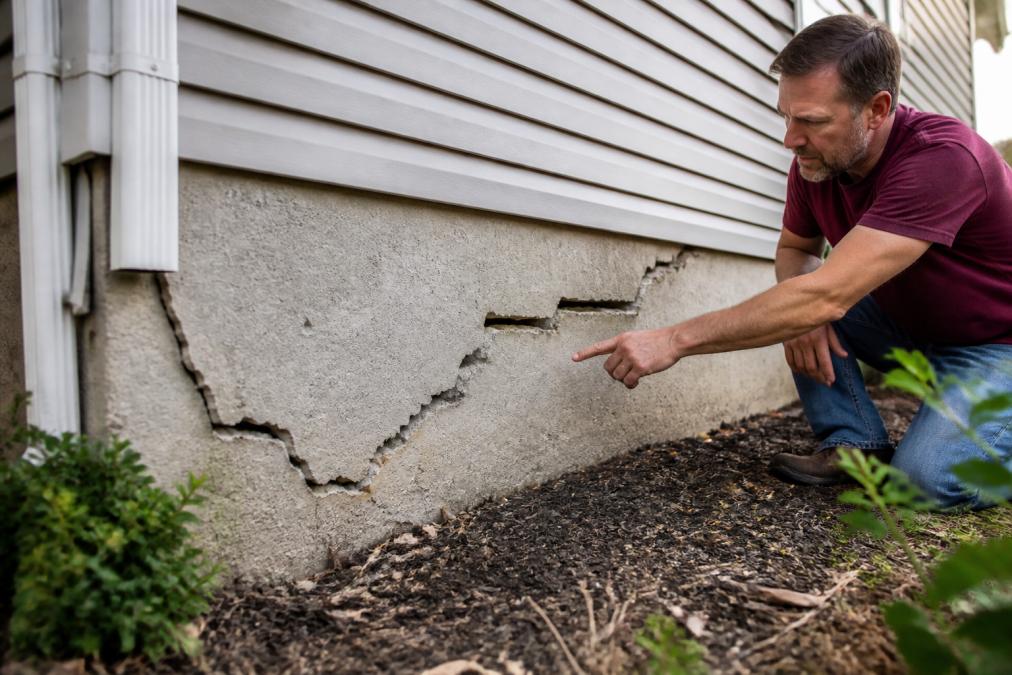
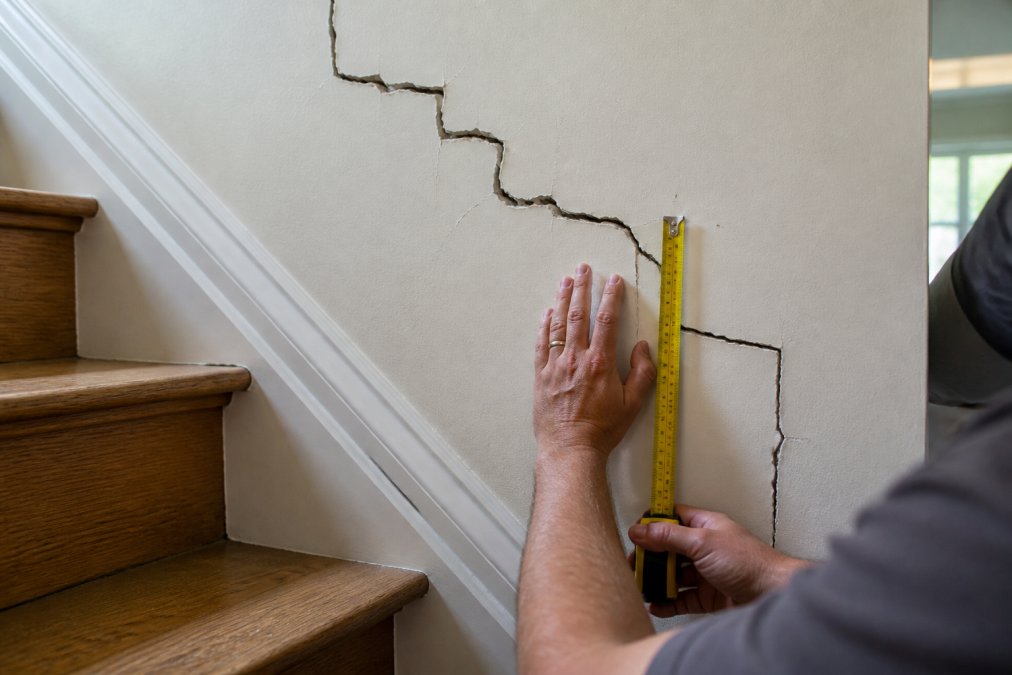
Start inside, walking every room and looking at the corners of doorways and windows, where stress concentrates. When you find a crack, measure its width at the widest point and note the direction it travels. Vertical and stair-step cracks that follow mortar lines are common; horizontal cracks are less common and typically more concerning.
Trace the crack to feel whether the edges are smooth or jagged. Mark the endpoint with a pencil and date it. Recheck in a few months; if the mark has moved or the gap has widened beyond roughly a quarter of an inch, the movement is ongoing and worth professional attention.
5 Common Signs of Foundation Settling in Homes
The most reliable signs of foundation settling in homes show up around doors and windows, along drywall seams, and across flooring. These symptoms rarely appear all at once, but each tells a similar story about how the structure is moving.
Sticking Doors and Windows
When a door suddenly scrapes the floor or a window refuses to latch, the frame has shifted out of square. Door frames that were perfectly plumb become rhomboid as one side of the house drops. Pay attention to doors that worked fine for years and then stick only during certain seasons, that pattern often points to soil expansion and contraction with moisture changes rather than a one-time event.
Cracks in Drywall and Ceilings
Hairline cracks are normal as new homes cure, but repeating cracks tell a different story. Look for cracks that follow drywall tape at ceiling corners, where structural stress commonly appears. Diagonal fissures radiating from doorway and window corners are classic signs of differential movement. If the crack is wide enough for a coin's edge, or you see nail pops where fasteners have worked loose, the movement has been significant.
Uneven or Sloping Floors
Place a marble or level on your floor in several rooms. If it rolls consistently toward one wall, the floor has a noticeable slope. A slight slope you have always known about is different from a new one that develops over a short period. Sudden sagging suggests a more urgent issue, such as a failing support beam or a problem with a pier and beam foundation, rather than gradual settling.
Causes of Foundation Settling: Why Your Home Is Moving
Understanding the causes of foundation settling helps you predict whether the movement will continue. The most common driver is the soil itself, but the specific mechanics of how soil behaves under your home often separate a temporary nuisance from a structural problem.
The Role of Soil Composition and Moisture
The type of soil your home sits on is the single biggest factor in how it settles. Two soil types dominate U.S. residential construction: expansive clay and sandy or granular soil. They behave in opposite ways.
Expansive clay soils (common in states like Texas, Colorado, and California) act like a sponge. They absorb water and swell, then release water and shrink. This cycle of heave and contraction is not uniform across your property. One side of the house may sit on soil that is wetter due to a leaking downspout, while the other side stays dry. This differential movement is what causes the diagonal cracks and sticking doors you see inside. The U.S. Geological Survey notes that this seasonal moisture change is a primary factor in ground movement beneath structures. Guidance from the U.S. Geological Survey on how soil and water affect ground movement
Sandy or granular soils (common in coastal and desert regions) drain quickly and do not expand, but they are prone to erosion. If water flows through the soil beneath a slab, it can carry fine particles away, leaving voids that the foundation settles into, often suddenly.
The 'Tree Effect' and Transpiration
Large trees planted within 15 to 20 feet of the foundation are a frequent cause of localized settling. Their roots extend deep and wide, drawing moisture from the soil directly beneath your foundation. This process, called transpiration, creates a localized 'dry zone' under one corner of the slab; as the clay dries, it shrinks, and the corner of the house drops. This is why you often see the most significant settling on the side facing a large oak or poplar.
Poor Drainage and Hydrostatic Pressure
Poor drainage compounds the problem. When downspouts dump water close to the foundation, the soil becomes saturated and loses its load-bearing capacity, leading to hydrostatic pressure against basement walls and gradual erosion beneath the slab. The International Residential Code (IRC) recommends a minimum slope of 6 inches over the first 10 feet away from the foundation (iccsafe.org). If your grade is flat or slopes toward the house, you are actively inviting water to saturate the soil.
Seasonal Settling Patterns: When to Worry
Foundations often move more during dry summers or wet winters, but this is often temporary. Clay soil that shrinks in a summer drought often re-expands when autumn rains return, which is why a door that sticks in August may work perfectly in November. The critical distinction is whether the movement reverses with the seasons or accumulates. If a crack widens every summer but closes again in winter, it is likely seasonal heave. If it simply gets wider year after year without closing, the soil is not rebounding, and the settlement is progressive.
A Practical Soil Test
Get a preliminary idea of your soil type with a simple test. Take a handful of soil from about 12 inches deep near your foundation, dampen it, and roll it into a ball. If it forms a smooth, shiny ribbon that holds together, it is high in clay. If it crumbles, it is sandy or silty. This is not a substitute for a geotechnical assessment, but it tells you whether your soil is prone to expansion or erosion, and that knowledge changes how you interpret the signs inside your home.
Normal Settling vs. Structural Failure: How to Tell the Difference
Not every crack means your foundation is failing. Normal settling is finite: the house moves a small amount, the soil reaches a new equilibrium, and the movement stops. Structural failure means the movement is ongoing and progressive.
A useful distinction is between settlement and sinking. Settlement refers to the initial, expected compression of the soil under the weight of the home. Sinking, or subsidence, is a more serious condition where the ground beneath the foundation is actually moving away, often due to erosion, poorly compacted fill, or a dropping water table.
The table below summarizes how to distinguish the two scenarios.
| Indicator | Normal Settling | Structural Concern |
|---|---|---|
| Crack width | Hairline, under 1/8 inch | Widening beyond 1/4 inch |
| Crack type | Vertical or stair-step | Horizontal or diagonal |
| Movement over time | Stops after initial period | Continues month to month |
| Doors and windows | Minor seasonal sticking | New, persistent misalignment |
| Floors | Slight, stable slope | New sagging or bouncing |
One of the best indicators is whether signs appear suddenly or gradually. Cracks that develop over a decade are far less alarming than a new crack that opens several millimeters in a single season. Likewise, settlement affecting only one corner of the home, creating diagonal fissures wider at the top, points to differential movement that deserves a closer look.
When to Call a Structural Engineer
If you have confirmed that cracks are growing, floors are sloping, or doors are jamming in new ways, the next step is a professional evaluation. A structural engineer, not a general contractor or the company that will perform the repair, is the right person to assess the foundation. An engineer provides an independent opinion about whether the movement threatens the home's structural integrity and, if it does, what repairs are actually necessary.
The American Society of Civil Engineers guidance on when to seek a structural assessment recommends professional evaluation when visible signs of distress appear in load-bearing walls or major structural elements. A foundation inspection by an engineer typically involves checking the levelness of the floors, examining the condition of the crawl space or slab, and looking at the exterior for signs of soil movement or drainage problems.
Bring your documentation to the inspection; the dates and measurements you recorded will help the engineer determine whether the movement is active or stabilized. Be wary of fear-based sales tactics from repair companies. A qualified engineer has no financial interest in recommending underpinning or pier installation, so their assessment is the most objective information you can obtain.
Foundation Repair Cost: What to Expect and How to Budget
Foundation repair cost is the question on every homeowner's mind, and it has the widest range of answers. The final number depends on the type of foundation, the extent of the damage, and the repair method required. You can build a realistic budget by understanding the typical cost bands for each repair category and the factors that drive them.
Typical Cost Ranges by Repair Type
Most foundation repair contractors in the United States quote within these general ranges for common repairs:
- Epoxy or polyurethane crack injection (interior): $300 to $800 per crack. This seals the crack to prevent water intrusion but does not address structural movement.
- Exterior crack repair and waterproofing: $2,000 to $6,000. This involves excavating next to the foundation, repairing the crack, and installing a drainage membrane.
- Piering or underpinning (steel push piers): $1,000 to $3,000 per pier. Most homes require 6 to 10 piers, putting a full job in the $6,000 to $30,000 range.
- Slab jacking or mudjacking: $500 to $1,500 per slab section. This is used for settled concrete slabs, not full foundation support.
- Full foundation replacement: Rare, but can exceed $40,000 for a complete rebuild.
These are planning figures, not quotes. The actual price is driven by the depth to stable soil, the accessibility of the foundation, and local labor and material costs.
The Hidden Cost: Disclosure and Resale Value
One of the most significant financial impacts of foundation settling is not the repair itself, it is the effect on your home's resale value. In most states, sellers must legally disclose known material defects, and foundation issues are at the top of that list. If a structural engineer has confirmed active settlement, you must disclose this to potential buyers.
This disclosure does not automatically kill a sale, but it changes the negotiation. Buyers will typically request a credit or price reduction to cover future repairs. A home with a documented, repaired foundation issue (with an engineer's sign-off) often sells at a 3% to 5% discount compared to a comparable home with no history of settlement. A home with an unrepaired or undocumented issue can lose 10% or more of its value, and many buyers will walk away entirely.
The Cost of Doing Nothing
Delaying a repair is rarely a money-saving strategy. A small crack monitored and repaired early costs a fraction of what the same issue costs after several seasons of water damage and progressive movement. If water enters through an unsealed crack, you add the cost of basement waterproofing, mold remediation, and potential damage to HVAC equipment or stored belongings. The structural repair that might have cost $8,000 today can easily become a $20,000 project next year.
Budgeting for the Assessment First
The most honest answer is that you need a specific assessment to know what you are facing. A structural engineer's inspection typically costs between $300 and $700, depending on your region and the size of the home. This is the best money you can spend, it gives you an independent, non-sales-oriented diagnosis and a written report you can use to get competitive bids from contractors.
When you are ready to address the damage, work with a contractor who will be honest about whether the issue is cosmetic or structural. Cole Home Service & Landscape Construction provides comprehensive home improvement and renovation services, including interior remodels, kitchens, bathrooms, and flooring. They pride themselves on delivering honest craftsmanship, reliable communication, and personalized attention to every project.
Frequently Asked Questions
When to worry about foundation settling?
You should worry when cracks are wider than 1/4 inch, when doors and windows consistently stick, or when floors feel noticeably uneven. Horizontal cracks or stair-step cracks in brick or block foundations are serious. Also watch for cracks that grow wider over a few months. These point to active movement, not just initial settling.
How much foundation settling is acceptable?
Most homes settle a small amount after construction as the soil compacts. Cracks narrower than 1/8 inch that appear once and stay stable are often cosmetic. The key is monitoring. Measure crack width monthly. If movement stops and cracks stay hairline, it is usually normal. If they widen, you need professional assessment.
How to tell the difference between house settling and foundation problems?
Normal settling causes minor, stable issues like a few hairline cracks or a door that sticks seasonally. Foundation problems cause progressive symptoms: cracks that widen, doors that stop latching, floors that slope visibly, and gaps between walls and ceilings. If symptoms appear suddenly or worsen over months, that points to structural movement.
Can foundation issues be fixed without major construction?
Some can. Minor cracks can be sealed with epoxy or polyurethane injections. Drainage fixes, like regrading soil or adding gutters, often stop the cause. Severe settling may require underpinning with piers. A structural engineer can tell you which approach is needed. Foundation repair cost depends on the method and extent of damage.