 listicle
Best Kitchen Cabinet Materials 2026: 8 Top Picks
Table of Contents
- Best Kitchen Cabinet Materials 2026: Quick Comparison
- 1. Solid Wood Cabinetry: Highest Durability, Highest Price
- 2. Plywood Cabinetry: The Balanced Choice
- 3. Moisture-Resistant MDF: Best for Painted Finishes
- 4. Melamine Cabinetry: Affordable and Easy to Clean
- 5. Laminate Cabinetry: High-Traffic Durability on a Budget
- 6. Engineered Wood Cabinetry: Consistent Quality, Lower Cost
- 7. Mixed-Material Cabinetry: Glass, Metal, and Leather Accents
- What Should You Know About Cabinet Finishes and Longevity?
- Frequently Asked Questions
Last Updated: October 1, 2026
Best Kitchen Cabinet Materials 2026: Quick Comparison
Choosing the best kitchen cabinet materials 2026 comes down to one trade-off: spend versus lifespan. This guide breaks down options, from solid wood to engineered composites.
| Material | Typical Cost | Durability | Best For |
|---|---|---|---|
| Solid wood | $150-$1,200 per linear ft | Highest | Luxury remodels |
| Plywood | $35-$81 per linear ft | High | Mid-range kitchens |
| Moisture-resistant MDF | Quote-based | Medium-high | Painted finishes |
| Melamine | $2,500-$5,000 per kitchen | Medium | Budget modern looks |
| Laminate | Quote-based | Medium-high | High-traffic kitchens |
| Engineered wood | $35-$81 per linear ft | Medium | Standard remodels |
| Mixed materials | $15,000-$25,000+ | Varies | Bespoke designs |
How We Evaluated These Cabinet Materials
We scored each material on structural integrity, moisture resistance, cost-effectiveness, and how well it holds up over a decade of daily cooking. Surface resistance and repairability mattered as much as looks, a cabinet that photographs well but swells after one leak is a bad investment.
1. Solid Wood Cabinetry: Highest Durability, Highest Price
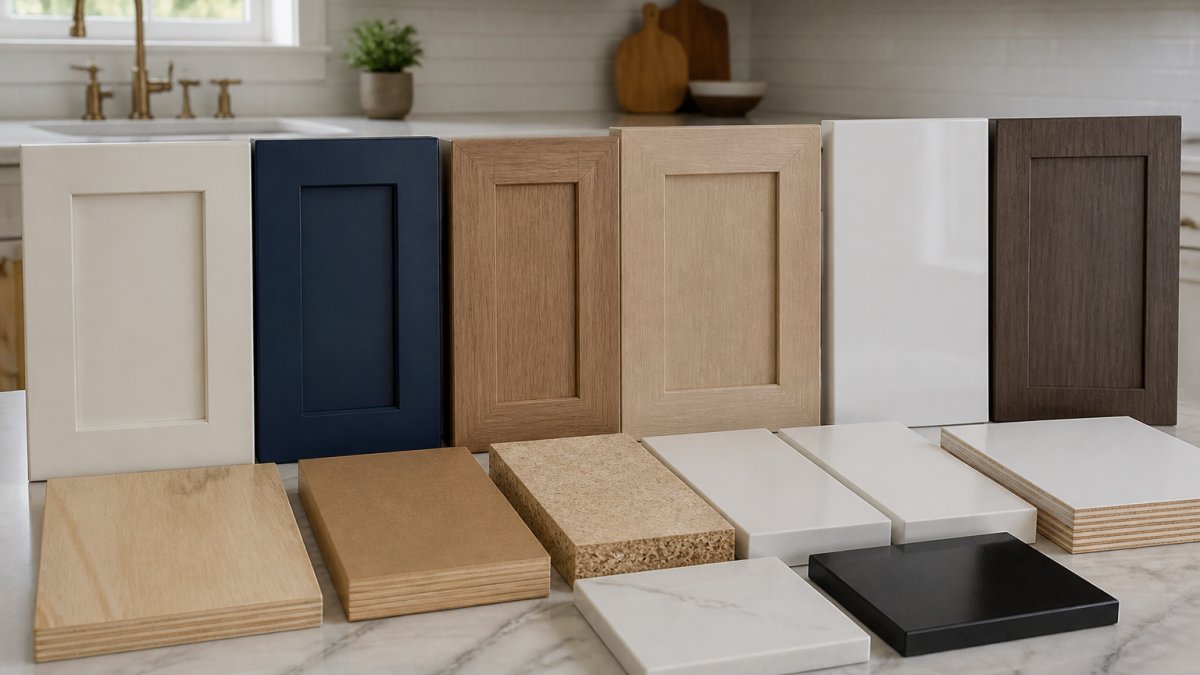
Solid wood cabinetry builds the entire box and door from natural timber like red oak or maple. It offers the best structural integrity and longest lifespan here, and resists dings and scratches far better than composites.
2. Plywood Cabinetry: The Balanced Choice
Plywood is the engineered wood product most cabinet makers reach for when they want strength without solid wood pricing. Its layers of wood veneer give it excellent screw-holding capability and far better moisture resistance than particleboard.
3. Moisture-Resistant MDF: Best for Painted Finishes
Moisture-resistant MDF is medium-density fiberboard treated to handle humid kitchen air. Its smooth, uniform surface takes matte or high-gloss paint better than any other material, which is why modern flat-front cabinets so often use it.
4. Melamine Cabinetry: Affordable and Easy to Clean
Melamine is a resin-coated composite used for cabinet interiors and modern exterior finishes. It shrugs off heat, stains, and moisture, comes in many colors and textures, and wipes clean in seconds.
5. Laminate Cabinetry: High-Traffic Durability on a Budget
Laminate bonds a thin protective layer to a substrate, creating a surface that stands up to scratches, impacts, and fading. It's the practical pick for busy households where cabinets take a beating.
6. Engineered Wood Cabinetry: Consistent Quality, Lower Cost
"Engineered wood" is an umbrella term, and treating it as one material is the biggest mistake buyers make. The category covers particleboard, MDF, and plywood cores, which behave very differently once installed. Precision manufacturing means every door and box matches and works with most standard hardware, but the core you choose decides how the cabinet handles your climate and how repairable it is.
Climate-Specific Performance: What the Rankings Don't Tell You
Most buying guides ignore climate. It's the variable that decides whether engineered cabinets last 8 years or 25.
- High-humidity climates (Gulf Coast, Southeast, coastal regions): Particleboard is the worst performer. Its loosely bonded core wicks moisture at cut edges and swells permanently. MDF performs better but still swells if water reaches the core. Plywood is the safest engineered choice because its cross-grain layers resist dimensional change. Insist on sealed edges, moisture-resistant cores, and a plywood box even if the doors are MDF.
- Arid climates (Southwest, high-desert regions): The opposite problem. Very low indoor humidity pulls moisture out of wood and composite cores, causing doors to shrink, joints to open, and painted MDF to hairline-crack at the seams. Solid wood is the most dimensionally reactive here; MDF and plywood are more stable. A whole-home humidifier set to 35-45% relative humidity is often the cheapest fix.
- Four-season climates with big indoor swings: The enemy is change, not any single condition. Cabinets in a kitchen with a wood stove or forced-air heat cycling on and off see repeated expansion and contraction. Plywood cores handle this best among engineered options.
Repairability: The Engineered Wood Reality
Engineered wood is generally not refinishable the way solid wood is. A swollen particleboard core can't be dried back to shape, and a delaminated melamine or laminate face is a replacement, not a repair. Painted MDF doors can be re-sprayed only if the substrate is intact. Practical takeaway: buy one extra door and drawer front per finish lot at installation, since dye lots shift between runs and a matching replacement two years later is often impossible.
How to Vet an Engineered Wood Cabinet Before You Buy
Ask the fabricator or dealer four questions:
- What is the core, particleboard, MDF, or plywood?
- Is the panel CARB Phase 2 or TSCA Title VI compliant for formaldehyde emissions?
- Are all exposed edges sealed, including the underside of wall cabinets and the back of drawer fronts?
- What is the moisture-resistance rating of the core, and is there a written warranty that covers swelling?
A dealer who can't answer these in writing is one to walk away from. The material itself is fine, the specification separates a cabinet that lasts from one that doesn't.
7. Mixed-Material Cabinetry: Glass, Metal, and Leather Accents
Mixed-material cabinetry combines glass, metal, or leather with traditional boxes to add texture and personality. These designs deliver high-end visual depth and blend industrial with organic elements, which is why they appear in custom kitchens needing a signature detail.
What Should You Know About Cabinet Finishes and Longevity?
The finish is a wear layer, not a cosmetic afterthought. It determines how a cabinet handles moisture, heat, grease, and the roughly 1,500 open-and-close cycles a busy kitchen door sees yearly. Two cabinets built from the same plywood box can perform very differently five years in, purely because of what was sprayed or laminated on top.
Matte vs. Glossy: What Actually Holds Up
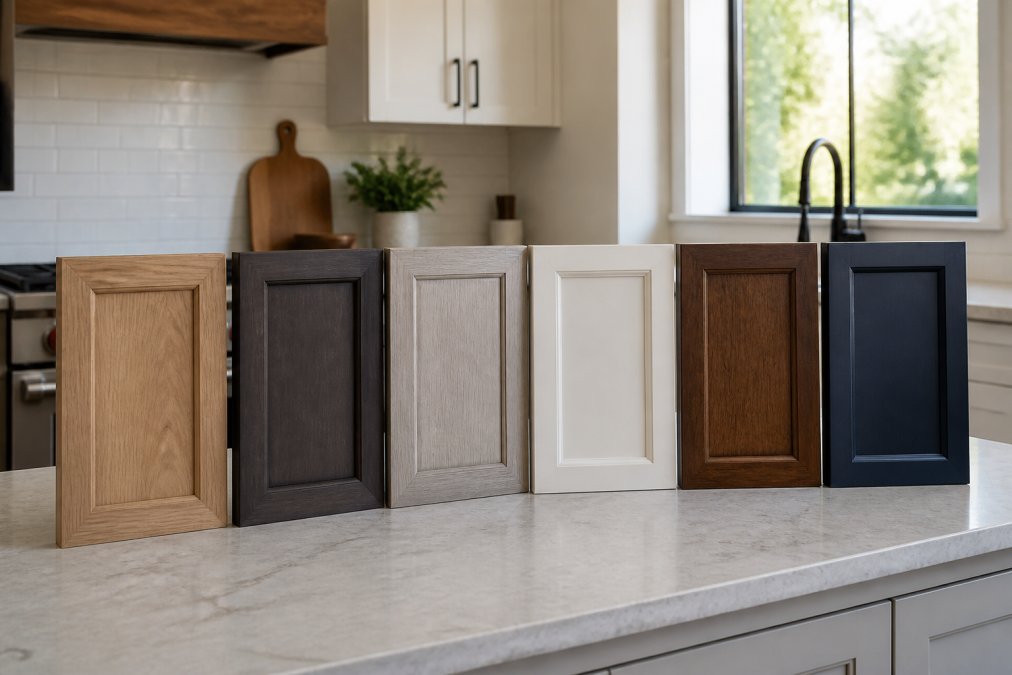
High-gloss finishes reflect light and make small kitchens feel larger, but show every fingerprint, water spot, and hairline scratch. Matte and textured finishes scatter light instead, hiding wear well in high-traffic rooms. The trade-off is cleanability: matte surfaces trap grease in their texture and need a soft cloth and mild soap rather than spray-and-wipe. A common pattern is matte on perimeter cabinets and gloss or semi-gloss on islands, seen from farther away.
VOC Emissions and Indoor Air Quality
Engineered wood products, MDF, particleboard, and many plywood cores, are bonded with adhesives that can off-gas formaldehyde and other volatile organic compounds (VOCs) for weeks after installation. The U.S. Environmental Protection Agency classifies formaldehyde as a probable human carcinogen, and the California Air Resources Board (CARB) sets some of the strictest emission limits through its ATCM Phase 2 rule.
Repairability by Material
This is where most buying guides stop, and it's the question that matters most five years in:
- Solid wood: Sandable and refinishable multiple times. A gouge can often be steamed out or filled with matching wax. Expect a full refinish to be viable every 10-15 years.
- Plywood with wood veneer: Repairable if the veneer layer is thick enough to sand lightly. Thin, paper-backed veneers can't be sanded without burning through.
- MDF: Not sandable at the edges, and a swollen core cannot be dried back to shape. Painted MDF doors can be re-sprayed, but any water damage means replacement.
- Melamine and laminate: Not refinishable. A chipped or delaminated door is a replacement, not a repair. Keep one spare door per finish lot if you can, dye lots shift between production runs.
Hardware Is the Cheapest Longevity Upgrade
Hinges and drawer slides take more mechanical abuse than any other cabinet part. Upgrading from builder-grade to soft-close, full-extension slides with a rated cycle count (many quality slides are tested to 50,000+ cycles) costs a fraction of new cabinetry and adds years of usable life. Look for slides rated for the load you'll put in the drawer, a 100-pound-rated slide in a pot drawer beats a 75-pound slide every time.
Match the material to the room, not the trend. A moisture-resistant box with a matte finish and quality hardware will outlast a prettier cabinet that swells the first time a pipe leaks.
Frequently Asked Questions
What is the most durable material for kitchen cabinets in 2026?
Solid wood ranks highest for structural integrity and longevity, with plywood a close second for moisture resistance. According to manufacturer data, solid wood resists dings and scratches better than composites, though it can warp with humidity swings. Plywood offers excellent screw-holding capability and handles moisture better than particleboard. For most kitchens, plywood boxes with solid wood doors deliver the best balance of durability and cost.
Are plywood cabinets better than MDF for kitchen remodels?
It depends on your priorities. Plywood wins on moisture resistance and screw-holding strength, making it ideal for sink bases and dishwashers. Moisture-resistant MDF provides a smoother surface for painted finishes and resists cracking at joints, but it is heavier and can swell if the finish is compromised. For painted, flat-front designs, MDF is often the better choice. For structural boxes in humid areas, plywood is more reliable.
Which cabinet materials are trending for eco-friendly kitchens in 2026?
Sustainable materials with low VOC emissions are gaining traction. Look for plywood and MDF certified by the California Air Resources Board (CARB) Phase 2 or TSCA Title VI, which limit formaldehyde. Reclaimed wood and bamboo are also popular for their lower environmental impact. When comparing options, ask suppliers for documentation on material sourcing and emissions to ensure the cabinets meet current indoor air quality standards.
How do I choose between solid wood and engineered wood cabinets?
Choose solid wood if you want maximum durability, natural grain, and higher resale value, and you are prepared for the highest price point. Engineered wood, such as plywood or MDF, offers consistent quality, better stability in varying humidity, and a lower cost. For busy family kitchens, engineered wood with a quality finish often performs better than solid wood because it resists warping. Consider your budget, climate, and design goals.
What are the best low-maintenance cabinet materials for busy families?
Melamine and laminate are the easiest to clean and most resistant to stains, scratches, and moisture. Both wipe down with a damp cloth and do not require refinishing. However, they cannot be repaired if chipped. For a balance of low maintenance and repairability, plywood with a factory-applied laminate or thermofoil finish works well. Avoid unfinished wood and particleboard in high-traffic areas, as they show wear quickly.